Flyer sizes decide where a flyer can go and how much it can say. A letter-size flyer works on a bulletin board and as a takeout menu; a half-letter flyer fits a counter stack and a shopping bag; a 4 × 6 card-stock flyer slips into a wallet. Pick the wrong size and a good design ends up folded in a purse or lost on a crowded wall.
This guide covers the standard flyer sizes in the US, what each one is best for, the file dimensions with bleed, how they compare with the A4 and A5 sizes many templates use, and how to choose paper and layout for each. It is based on the flyers we print every week for salons, restaurants, bakeries and shops.
The standard flyer sizes in the US
US flyers follow the US paper system, built on the 8.5 × 11 inch letter sheet. Most flyers are that sheet, or the sheet cut in half or in quarters. These five cover nearly every small business need.
| Name | Size | Best for |
|---|---|---|
| Letter | 8.5 × 11 in | Takeout menus, weekly deals, bulletin boards, door hangers on a table |
| Half letter | 5.5 × 8.5 in | Counter stacks, bag inserts, hand-outs, grand opening flyers |
| Postcard size | 4 × 6 in | Card-like flyers for the counter, referral cards, bag inserts |
| Legal | 8.5 × 14 in | Long menus or price lists that need one more section |
| Tabloid | 11 × 17 in | Small posters for windows, doors and community boards |
The most common standard flyer size for small shops is still letter, 8.5 × 11 inches, closely followed by half letter. We print standard flyers in both, and premium flyers on thick cover stock at 4 × 6 and 5.5 × 8.5 inches.
Letter flyers: 8.5 × 11 inches
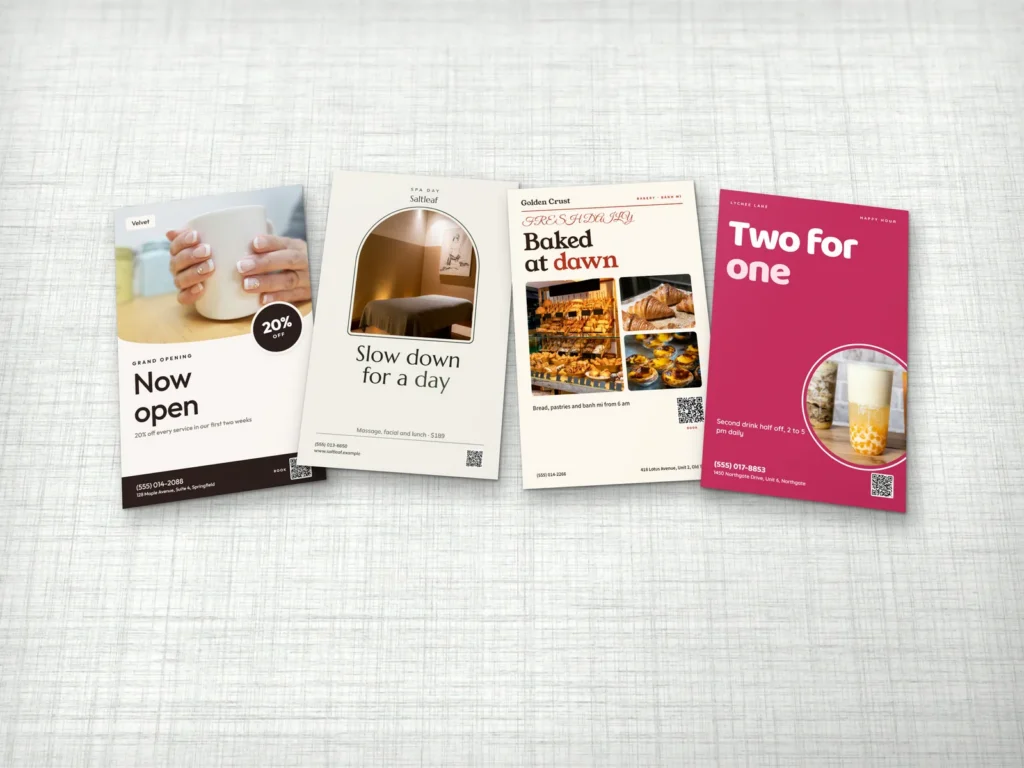
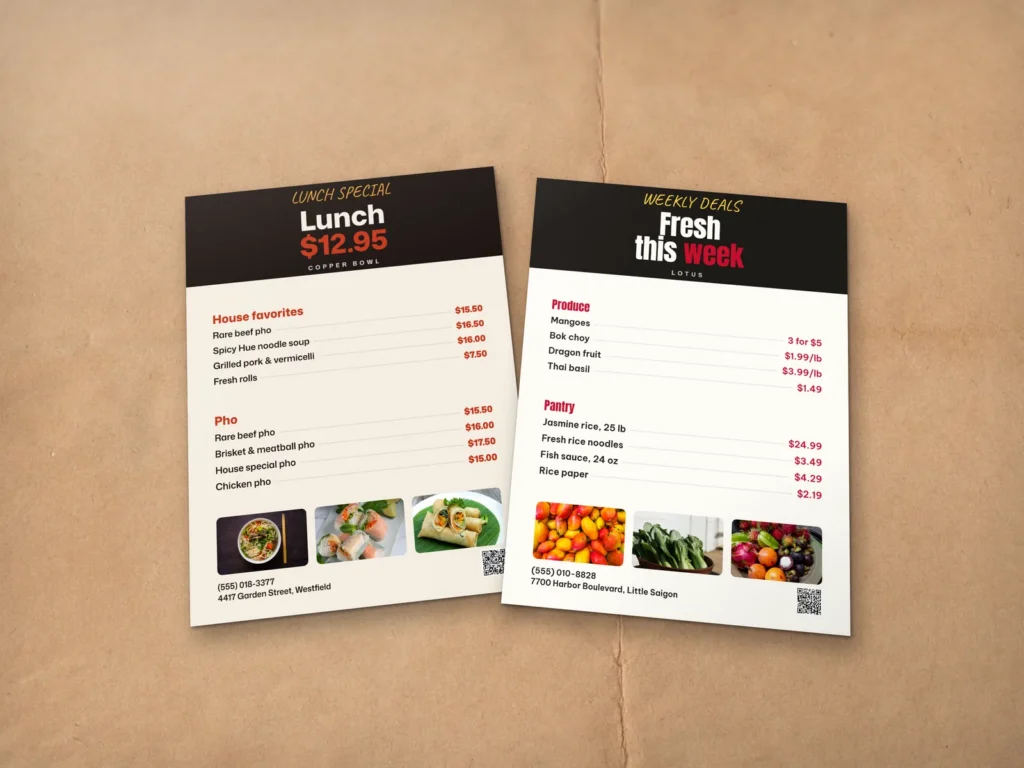
Of all flyer sizes, the letter flyer is the workhorse. It holds a full takeout menu, a list of weekly deals, a grand opening schedule or a service menu with prices. It fits standard bulletin boards, clear sign holders and the binders at front desks, and it is the size most people picture when they hear "flyer".
Use letter size when you have real content to show: a list of dishes with photos, a full price list, a map and directions. Keep a strong headline at the top, because a letter flyer is often read from a distance first. If the flyer will be handed out rather than posted, consider whether half letter could say the same thing in a more convenient size.
Half-letter flyers: 5.5 × 8.5 inches
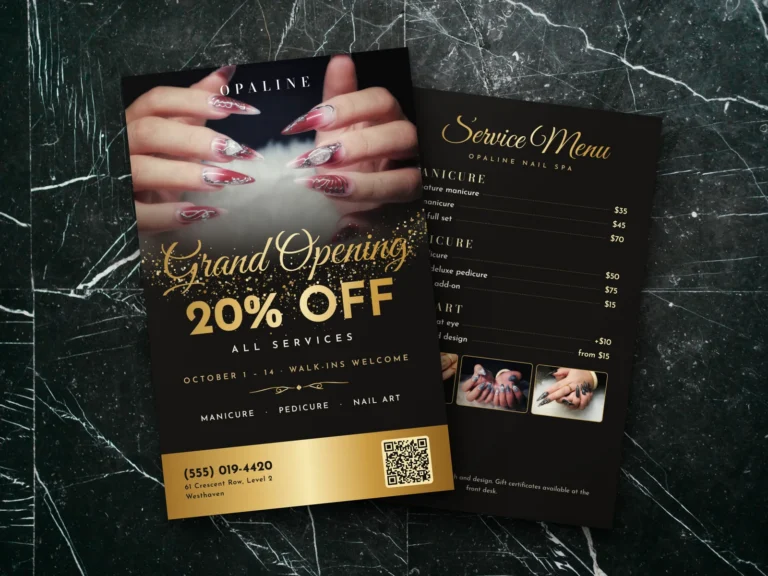
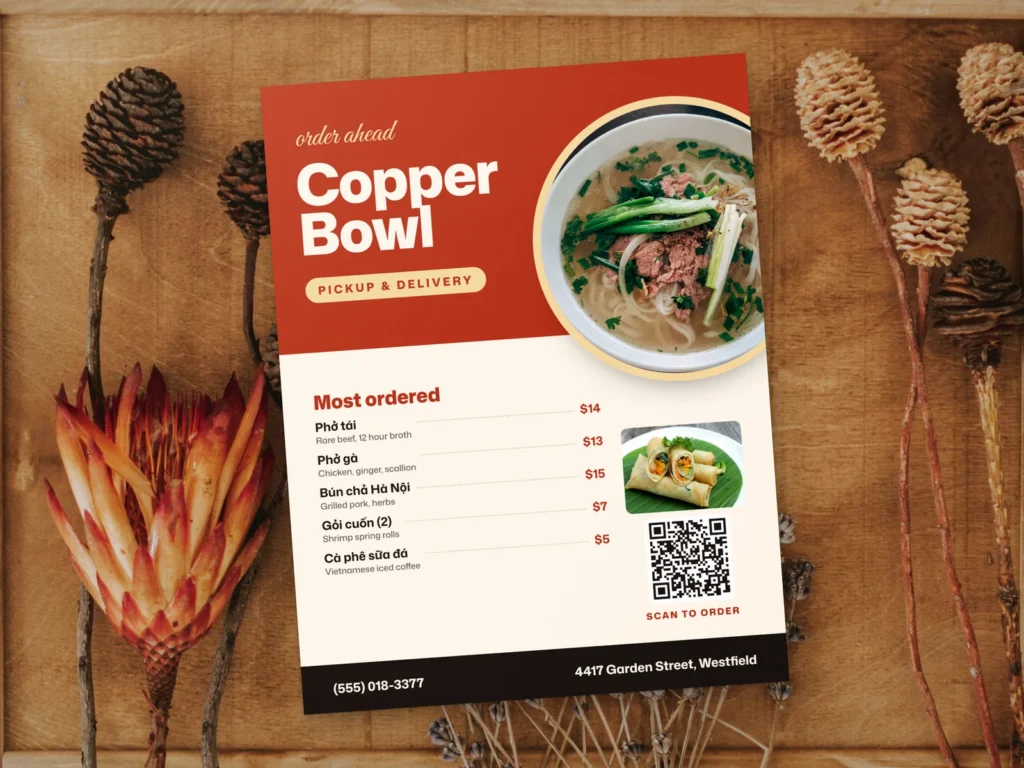
Half letter is the friendliest of the flyer sizes to hand out. It fits a hand, a bag and a counter stack, and it is big enough for a photo, an offer and a short list. Grand opening flyers, seasonal promotions, new service announcements and coupon flyers often work best at this size.
Because the space is smaller, a half-letter flyer should do one job. One offer, one photo, one call to action. If you find yourself shrinking text to fit, you may need letter size, or a second flyer.
4 × 6 inch flyers
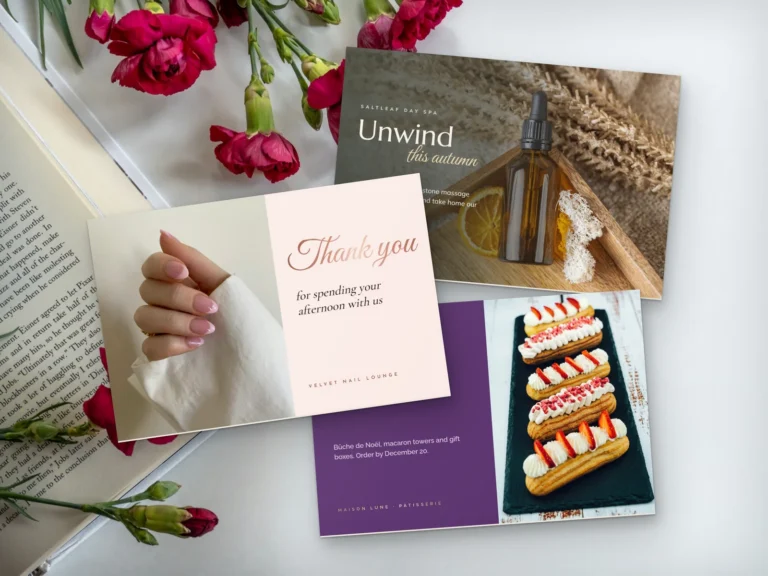
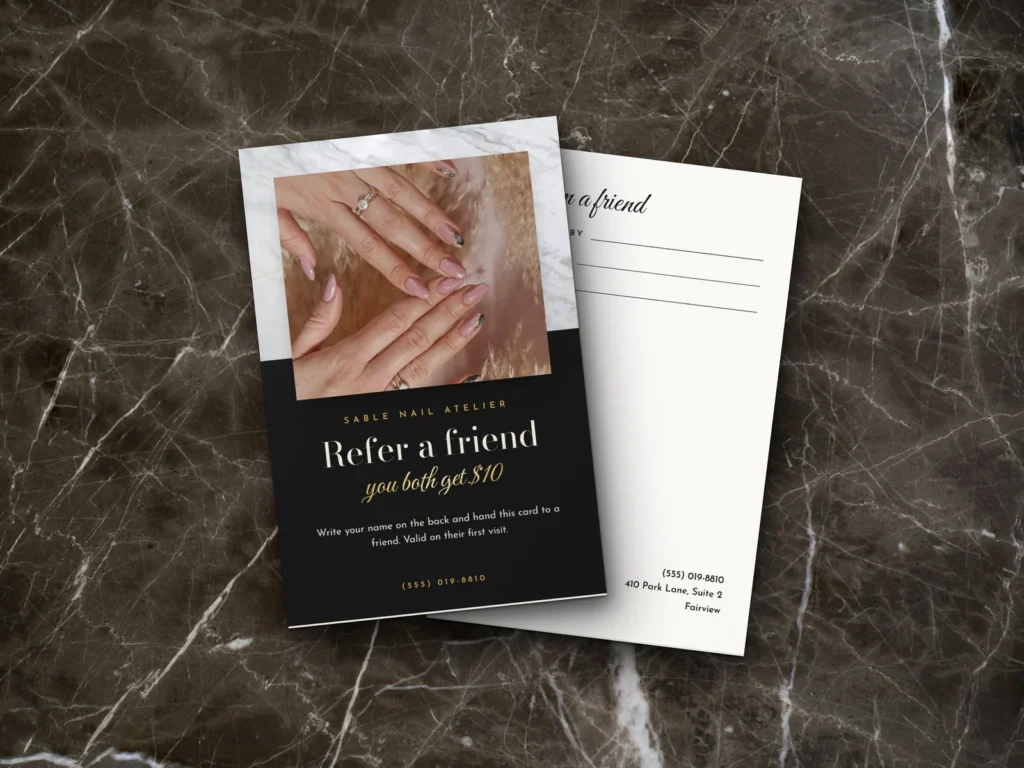
At 4 × 6 inches, the smallest standard flyer size we print, a flyer becomes a card. Printed on thick cover stock and on both sides, it feels like something worth keeping: a referral card, a first-visit offer, a "refer a friend" card, a card tucked into every order. The back gives you room for a price list, opening hours or a QR code.
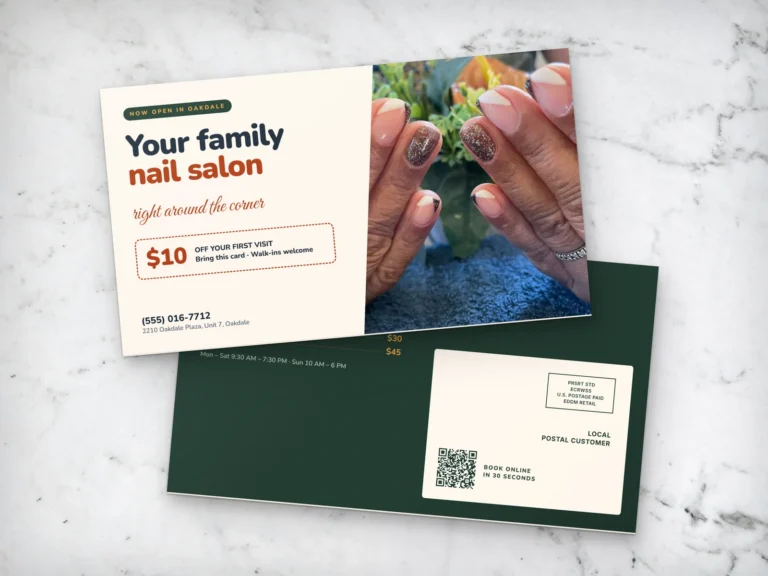
4 × 6 is also a standard postcard size, so the same design can be mailed to your client list. When you plan to mail, leave the address and stamp area on the back clear, or choose our postcards, which are laid out for mail.
Larger flyers and posters
When a flyer will be read from across a room or from the sidewalk, bigger flyer sizes help. A tabloid sheet, 11 × 17 inches, makes a good small poster for a shop window or a community board. Legal size, 8.5 × 14 inches, gives a long menu a little more room without becoming a poster.
For anything bigger, think about signs instead of flyers: a vinyl banner outside, window graphics on the glass, or a framed price board on the wall. Paper posters fade and curl; signs are made to last.
Flyer sizes compared with A4 and A5
Many online templates, and many printers outside the US, use the international A sizes. They are close to US sizes but not the same, which matters when you print a design made elsewhere.
| International size | Millimeters | Inches (about) | Closest US size |
|---|---|---|---|
| A4 | 210 × 297 mm | 8.27 × 11.69 in | Letter, 8.5 × 11 in |
| A5 | 148 × 210 mm | 5.83 × 8.27 in | Half letter, 5.5 × 8.5 in |
| A6 | 105 × 148 mm | 4.13 × 5.83 in | 4 × 6 in |
A4 is narrower and taller than letter. A design made at A4 and printed at letter size gets either white bands on the sides or a cropped top and bottom. If your template says A4 or A5, resize the layout to the US flyer dimensions before you export, or send it and we adjust it. The Wikipedia article on paper sizes lists both systems side by side if you want every number.
Flyer dimensions with bleed and safe area
Every flyer file needs 1/8 inch of bleed on each side and a safe area 1/8 inch inside the trim, whatever the flyer sizes you choose. Here are the flyer dimensions to type into your design app.
| Finished size | File size with bleed | Safe area for text |
|---|---|---|
| 8.5 × 11 in | 8.75 × 11.25 in | 8.25 × 10.75 in |
| 5.5 × 8.5 in | 5.75 × 8.75 in | 5.25 × 8.25 in |
| 4 × 6 in | 4.25 × 6.25 in | 3.75 × 5.75 in |
| 8.5 × 14 in | 8.75 × 14.25 in | 8.25 × 13.75 in |
| 11 × 17 in | 11.25 × 17.25 in | 10.75 × 16.75 in |
Our articles on bleed in printing and the print-ready PDF explain how to set these up in Canva and Adobe apps. If you start from one of our design templates, the size and bleed are already set.
How to choose between flyer sizes
Four questions settle it quickly.
- Where will the flyer live? On a wall or a board, go letter or larger. In a hand, a bag or a wallet, go half letter or 4 × 6.
- How much do you need to say? A full menu needs letter size. One offer fits half letter. One message with a code fits 4 × 6.
- How will people get it? Handed out at the door, left on the counter or posted on a board. Hand-outs should be easy to hold; posted flyers should be easy to read from a few steps away.
- How long should it last? A one-week special can be a light paper flyer. A card people keep for months deserves cover stock.
Most shops end up with two flyer sizes: a letter flyer for menus and deals, and a smaller card-stock flyer for offers and referrals. Keep both in the same design, with the same colors and logo, so a client who sees one recognizes the other. When you reorder, review whether each size still does its job: if the half-letter flyers keep running out and the letter flyers pile up, shift the next order toward the size people actually take.
Paper and finish for different flyer sizes
The size and the paper work together. A large flyer on thin paper feels flimsy; a small flyer on thick stock feels like a card.
- 100 lb paper (our standard flyers): a sturdy paper that feels better than office paper, good for letter and half-letter flyers that are handed out or posted. Choose gloss for photos and color, matte for a calm look or for writing on.
- 100 lb cover stock (our premium flyers): a thick, card-like stock printed on both sides, good for 4 × 6 and half-letter pieces people keep.
- Front only or both sides: a flyer posted on a wall needs only a front. A hand-out gains a lot from a printed back: a menu, a map, hours or a coupon.
Layout tips for different flyer sizes
Letter (8.5 × 11). Use a clear grid: headline across the top, a large photo, then two or three columns of content. Put your phone number and address at the bottom in large type. Leave margins generous; a letter flyer crowded edge to edge looks cheap.
Half letter (5.5 × 8.5). One headline, one photo, one offer, one call to action. Put supporting details, such as the full menu or the hours, on the back.
4 × 6. Treat it like a card: a strong image or a bold headline on the front, everything practical on the back. Keep text larger than you think; the small size tempts designers to shrink it.
Posters (11 × 17). Design for reading at a distance: a headline you can read from ten feet, few words, high contrast.
How much fits on each of the flyer sizes
Space fills up faster than most people expect, especially once the type is large enough to read. As a rough guide for readable flyers:
A letter flyer holds a headline, one large photo or a strip of three small ones, and a full menu or list of 20 to 30 short items in two or three columns, plus the address, phone number and a QR code at the bottom.
A half-letter flyer holds a headline, one photo, an offer of one or two lines, a short list of four to six items and the contact details. A full menu on the back is possible if the items are short.
A 4 × 6 flyer holds a headline and a photo on the front, and on the back an offer, a short list or the hours, plus the contact details and a QR code.
If your content does not fit with comfortable type sizes, move up a flyer size, split the content into two pieces, or move details to your website and add a QR code. Shrinking type to squeeze everything in is the one fix that never works.
Getting flyers into people's hands
Flyer sizes also decide how a flyer travels. A few distribution habits make every size work harder.
- Counter stacks. Half-letter and 4 × 6 flyers in a clear holder by the register are taken by clients who are already interested.
- Bag and order inserts. A 4 × 6 card in every shopping bag or takeout order reaches people at the moment they enjoyed your service.
- Community boards. Letter flyers and small posters for libraries, gyms, laundromats and coffee shops. Ask before posting, and replace them when the offer ends.
- Neighbor shops. A nail salon and a coffee shop next door can swap small stacks of flyers; their clients are often the same people.
- Events. Farmers markets, school fairs and local festivals are good places for half-letter flyers with an event-only offer.
One rule to know: in the US, mailboxes are only for mail with postage. Putting unstamped flyers in or on a mailbox is against federal law. To reach every home in an area, use EDDM printing instead, which delivers through the Post Office.
When a flyer should become a brochure
A letter-size sheet folded in thirds becomes a tri-fold brochure, with six panels instead of two sides. If your flyer is turning into a long document, such as a full service list, a wedding package or the story of your shop, a brochure organizes it better. Our tri-fold brochures are letter size flat, folded in three; premium brochures on thicker stock come as bi-folds, tri-folds or four-panel folds.
Common flyer size mistakes
| Mistake | What happens | Better choice |
|---|---|---|
| A full menu squeezed onto half letter | Type too small to read | Letter size, or a menu on the back |
| One short offer on a letter sheet | Lots of empty space, weak impact | Half letter or 4 × 6 |
| A4 template printed at letter | Cropped edges or white bands | Resize to the US flyer dimensions first |
| Thin paper for a card people keep | Bends and tears in a wallet | 4 × 6 on cover stock |
| Flyers in mailboxes | Against postal rules | EDDM mailers through the Post Office |
Ideas by trade
Nail salons and spas use half-letter flyers for seasonal promotions and 4 × 6 cards for refer-a-friend offers. Letter flyers carry the full service menu for the waiting area.
Restaurants use letter flyers as takeout menus, half-letter flyers for lunch specials and catering, and 4 × 6 cards tucked into delivery bags with an offer for the next order.
Bakeries and cafés use half-letter flyers for holiday preorders and 4 × 6 cards as loyalty or opening cards.
Retail shops use half-letter flyers for sales and events, and small posters in the window for new arrivals.
Questions about flyer sizes
What is the most common standard flyer size?
In the US, letter size, 8.5 × 11 inches, followed by half letter, 5.5 × 8.5 inches. Both use standard US paper sizes.
What size should a flyer be for a grand opening?
Half letter, 5.5 × 8.5 inches, is easy to hand out and holds a date, an offer and a photo. Pair it with a banner on the building and a few letter-size flyers on local boards.
Is a 4 × 6 flyer the same as a postcard?
The size is the same. A postcard has a back laid out for mailing, with space for an address and a stamp. A 4 × 6 flyer can use the back for anything.
Can I print an A4 design as a letter flyer?
Yes, but the shapes differ, so the design must be resized or it gets cropped or white bands. Send it and we adjust it to the US flyer dimensions before the proof.
What paper should I choose for flyers?
For hand-outs and posted flyers, 100 lb paper in gloss or matte. For flyers people keep, such as referral cards, thick 100 lb cover stock printed on both sides.
What flyer dimensions do I give a designer?
The finished size plus 1/8 inch of bleed on each side, and a safe area 1/8 inch inside the edge. For a letter flyer, that is a file of 8.75 × 11.25 inches with text inside 8.25 × 10.75 inches.
Can I order two flyer sizes with one design?
Yes. We adapt one design to both flyer sizes, for example letter for boards and half letter for hand-outs. Each size gets its own proof, because the layout changes a little between them.
Can I print flyers on one side only?
Yes. Flyers for walls and boards often need only a front. For hand-outs, a printed back usually earns its keep.
The short version
Choose the flyer size by where it goes and how much it says. Letter, 8.5 × 11 inches, for menus, deals and boards. Half letter, 5.5 × 8.5 inches, for hand-outs and promotions. 4 × 6 inches on card stock for offers and referrals people keep. Larger sizes for windows and boards. Set up the file with 1/8 inch of bleed, keep text inside the safe area, and resize A4 or A5 templates before printing.
When you know your size, add standard flyers or premium flyers to your quote list. Not sure which of the flyer sizes fits your job? Describe it in the request and we suggest one, as part of our design and printing services.