The standard business card size in the United States and Canada is 3.5 × 2 inches, which is 88.9 × 50.8 millimeters. That one number is easy to remember, but a print file needs two more: the size with bleed (3.75 × 2.25 inches) and the safe area where text belongs (3.25 × 1.75 inches). Get those three right and your cards come back cut clean, with nothing important trimmed.
This guide covers the standard business card size in every unit a design app asks for, how it compares with card sizes in other countries, the shapes and sizes worth considering instead, and how to lay out a 3.5 × 2 inch card so people can read it at a glance. We print business cards every week, so the numbers below are the ones our own designers use.
The standard business card size in the US
A US business card measures 3.5 inches wide and 2 inches tall when it is held horizontally. Turned upright, a vertical card is 2 × 3.5 inches; it is the same card, just a different layout. The size fits wallets, card holders on a front desk and the card slots of most phone cases, which is why nearly every printer in the country uses it as the default.
Here are the business card dimensions you need for a print file, in inches, millimeters and pixels at 300 pixels per inch, the resolution printers expect.
| Area | Inches | Millimeters | Pixels at 300 ppi |
|---|---|---|---|
| Finished card (trim) | 3.5 × 2 | 88.9 × 50.8 | 1050 × 600 |
| File with 1/8 in bleed | 3.75 × 2.25 | 95.25 × 57.15 | 1125 × 675 |
| Safe area for text | 3.25 × 1.75 | 82.55 × 44.45 | 975 × 525 |
If your design app asks for a "document size", enter the standard business card size of 3.5 × 2 inches and add 0.125 inch of bleed in its bleed setting. If it has no bleed setting, enter the size with bleed and keep in mind that the outer 1/8 inch will be cut away.
Standard business card size with bleed and safe area
The three rows of that table are three lines on your file. The bleed line, at 3.75 × 2.25 inches, is where your background color or photo must reach. The trim line, at 3.5 × 2 inches, is where the cutter cuts. The safe area, at 3.25 × 1.75 inches, is where every word, number and logo must stay.
Why so much fuss about 1/8 inch? Because business cards are printed many to a sheet and cut in stacks, and a cut can land a hair off. The bleed hides that on the outside; the safe area protects your phone number on the inside. Our article on bleed in printing explains the three lines in more detail, and the guide to a print-ready PDF shows how to export them from Canva or Adobe apps.
A quick test: if you print your design at home on plain paper and cut it out along the trim, could you lose 1/16 inch on any side without cutting into a letter? If yes, your layout respects the safe area.
Business card sizes around the world
There is no single world standard, and that matters if you hand out cards to visitors from abroad or order cards printed overseas. Most countries use something close to the size of a credit card, but not quite the same.
| Where | Card size | In inches (about) |
|---|---|---|
| United States and Canada | 88.9 × 50.8 mm | 3.5 × 2 |
| United Kingdom and much of Western Europe | 85 × 55 mm | 3.35 × 2.17 |
| Vietnam, Australia, New Zealand, India and others | 90 × 55 mm | 3.54 × 2.17 |
| Japan | 91 × 55 mm | 3.58 × 2.17 |
| China, Hong Kong, Singapore, Malaysia | 90 × 54 mm | 3.54 × 2.13 |
| Credit card size (ISO/IEC 7810 ID-1) | 85.6 × 53.98 mm | 3.37 × 2.13 |
The list comes from the Wikipedia article on business cards, which also notes that no international standard exists. For a shop in the US, the standard business card size of 3.5 × 2 inches is the right choice: it is what your clients' wallets and your card holder expect. If a relative prints cards for you in Vietnam, expect them a little taller than American cards.
Horizontal or vertical?
Both use the same business card dimensions, so the choice is about layout, not size. Horizontal cards read like a sign: logo on one side, details on the other, easy to scan in a second. Vertical cards feel more modern and suit a tall logo, a photo of your work or a short list of services.
A simple rule: let your logo decide. A wide logo sits better on a horizontal card; a round or stacked logo often looks better on a vertical one. Whichever you choose, keep the same direction on both sides of the card; the business card size does not change, only the way it is read. A card that must be turned sideways to read the back is a small annoyance every time someone flips it.
Other shapes and sizes worth considering
The standard business card size is the safe default, but not the only option. These are the alternatives our customers ask about most.
- Plastic cards at credit card size. At 3.375 × 2.125 inches with rounded corners, plastic cards feel like a bank card and last for years. They are the right choice for gift cards, memberships and loyalty programs your POS scans, but not for everyday business cards you hand out by the hundred.
- Thick triple-layer cards. Triple-layer business cards keep the 3.5 × 2 inch size and press three sheets together, with a colored middle layer that shows on the edge.
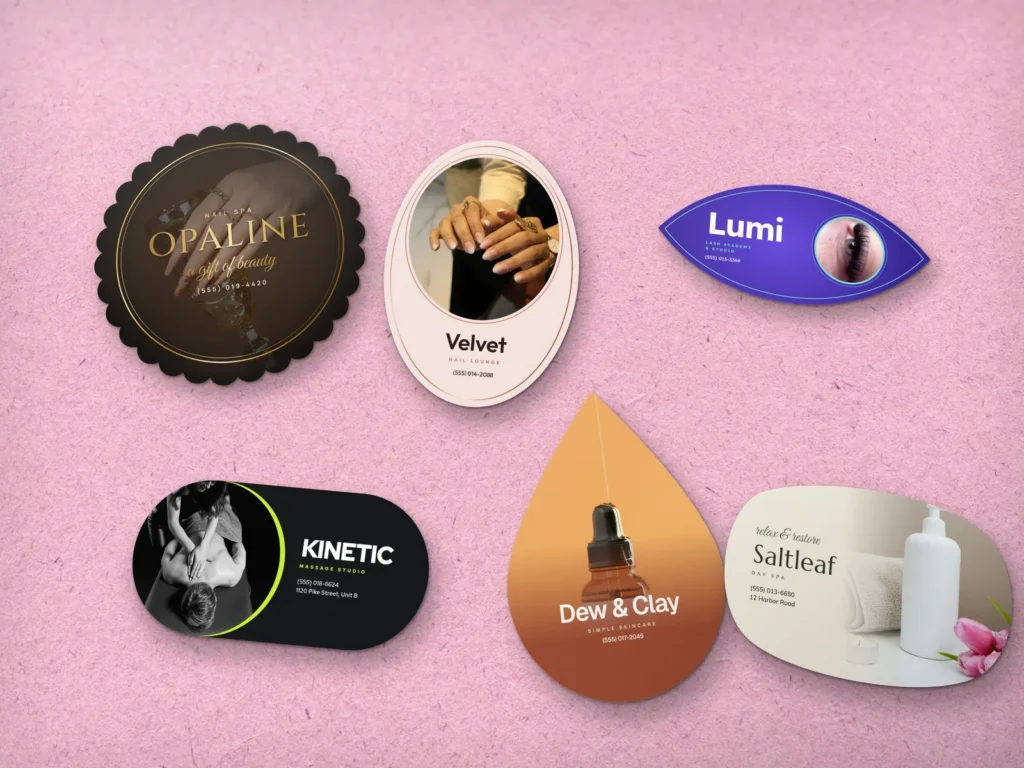
- Shaped and folded cards. Die-cut business cards are cut to a shape: round, oval, leaf, rounded square or with one rounded corner. A folded card opens to twice the space, for a full service list or a loyalty grid.
- Rounded corners. Rounded corners do not change the size; they soften the look and stop corners from bending in a wallet.
For most shops, a standard card with a well-used back beats a special size. Special sizes stand out, but they also miss card holders and slots made for 3.5 × 2 inches. You can browse every option in our business card category.
How to lay out a 3.5 × 2 inch card
A business card is small, and it is read at arm's length, often in a hurry. A good layout puts one thing first, two or three things second, and leaves the rest out.
Pick the first thing. For a shop, it is usually the name and logo. For a person, it is their name. Make it clearly larger than everything else.
Choose the second things. Phone number, address or website, and one social handle. Most clients want to call, text, find you on a map or book online; give them the one or two ways they use.
Leave space. White space is not wasted; it is what makes the rest readable. A card with eight lines of text in the safe area of 3.25 × 1.75 inches is hard to read for anyone over forty.
| Element | Smallest size we suggest | Why |
|---|---|---|
| Business name | 12 pt and up | The first thing people should see |
| Phone number | 9 to 10 pt | Must be readable without glasses |
| Address and website | 8 to 9 pt | Read once, then typed into a phone |
| Fine print | 7 pt | Anything smaller blurs, especially on textured stock |
| QR code | 0.75 × 0.75 in | Smaller codes are hard for older phones to scan |
Use dark text on a light background or light text on a dark one, never mid-gray on mid-gray. Thin script fonts look elegant on screen but lose detail at 8 points; save them for the name and keep the details in a plain, sturdy typeface.
Choosing paper for a 3.5 × 2 card
The standard business card size stays the same whatever stock you choose, but the paper changes how the card feels in the hand. Our standard cards come in two thicknesses: 14 pt, a solid everyday card, and 16 pt, a little stiffer, which most people notice as "a good card" the moment they hold it.
The finish matters as much as the thickness. Gloss makes photos rich and colors deep; it suits nail art, food and bright brands. Matte has a calm, smooth surface that reads well under strong lights and takes a pen, which is why we suggest it for appointment and reward cards that get written on. If you want a card that feels expensive at the same business card size, triple-layer stock presses three sheets into one thick card with a colored core.
Business card size for salons, restaurants and shops
Every trade uses the same business card dimensions, but not in the same way. The size is fixed; what you put on it should follow how your clients use the card.
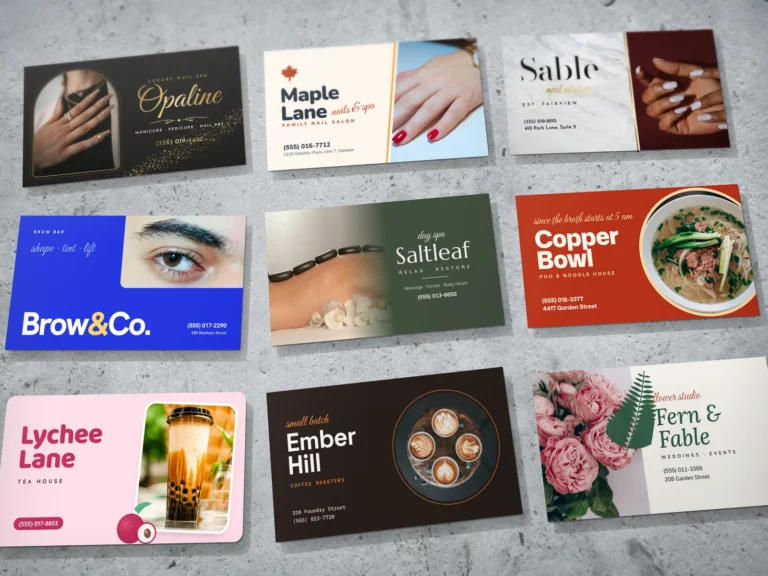
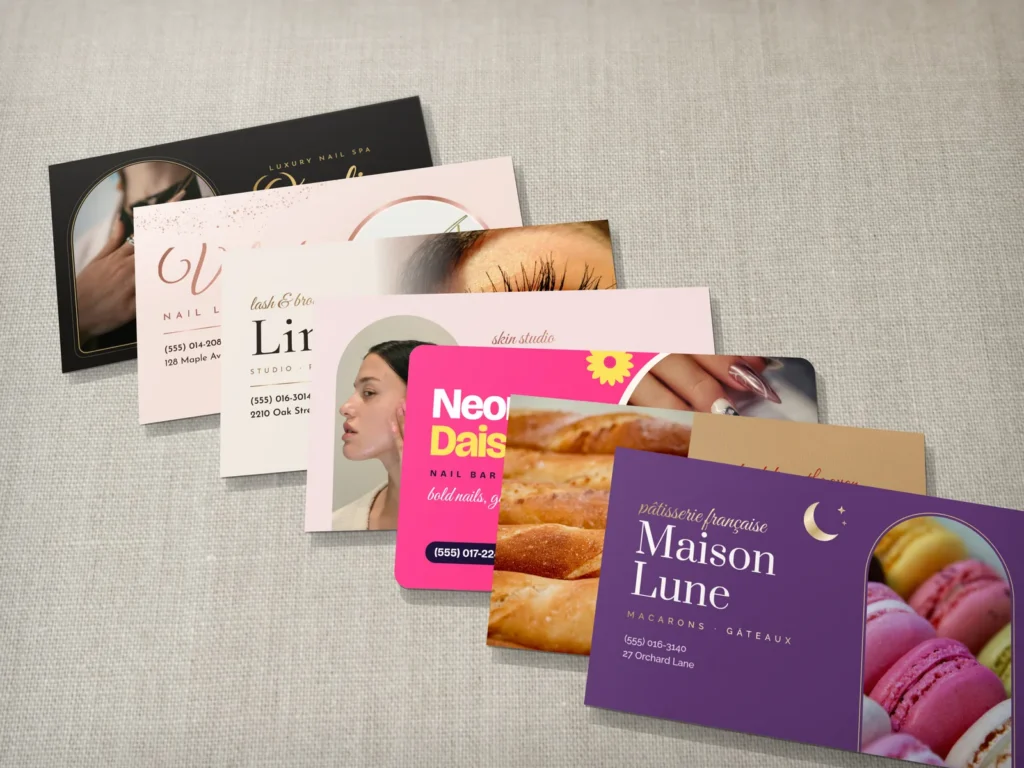
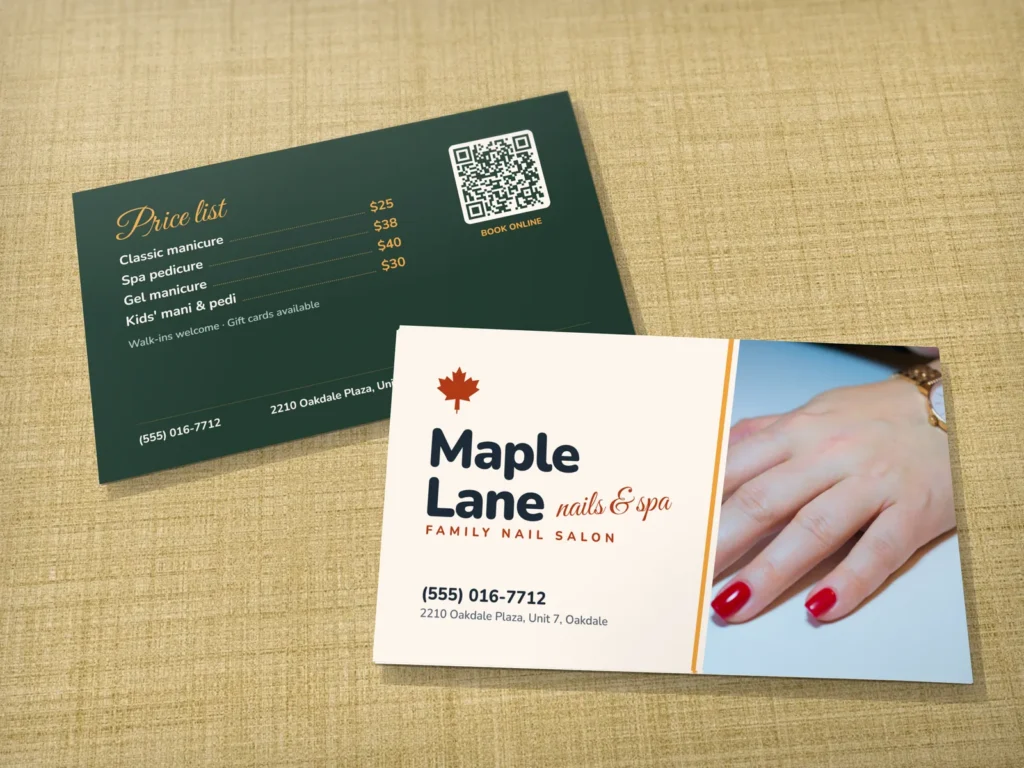
Nail salons, spas and lash studios hand a card over at the end of a visit, so the back works hardest as an appointment card or a reward card. Keep the front simple: name, logo, phone, address, booking link.
Restaurants and cafés often leave a stack by the register. The front carries the name and a food photo; the back holds opening hours, a menu QR code and a delivery or catering line.
Bakeries and coffee shops turn the card into a loyalty card: ten coffee cups or cupcakes to stamp, with the reward in bold. A matte finish takes stamps and pen marks best.
Retail shops and florists use the card as a small ad tucked into every bag: a photo of the shop, the website and an Instagram handle.
Whatever your trade, the standard business card size is small enough that every element must earn its place. Decide what the card is for, then design for that one job.
Use the back of the card
The back of a 3.5 × 2 inch card is free space you already pay to cut, and a printed back turns a card into a tool. These are the backs our customers choose most:
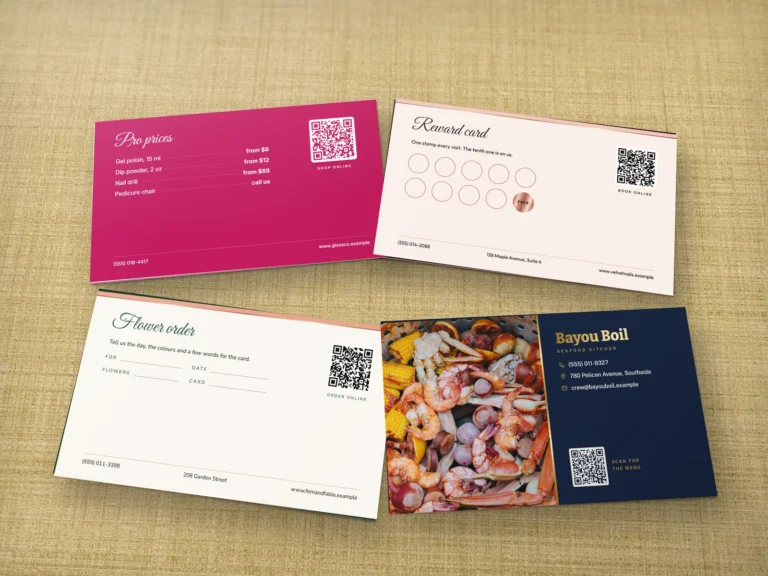
- Appointment card. Lines for the date and time of the next visit. Ideal for salons, spas, lash studios and clinics.
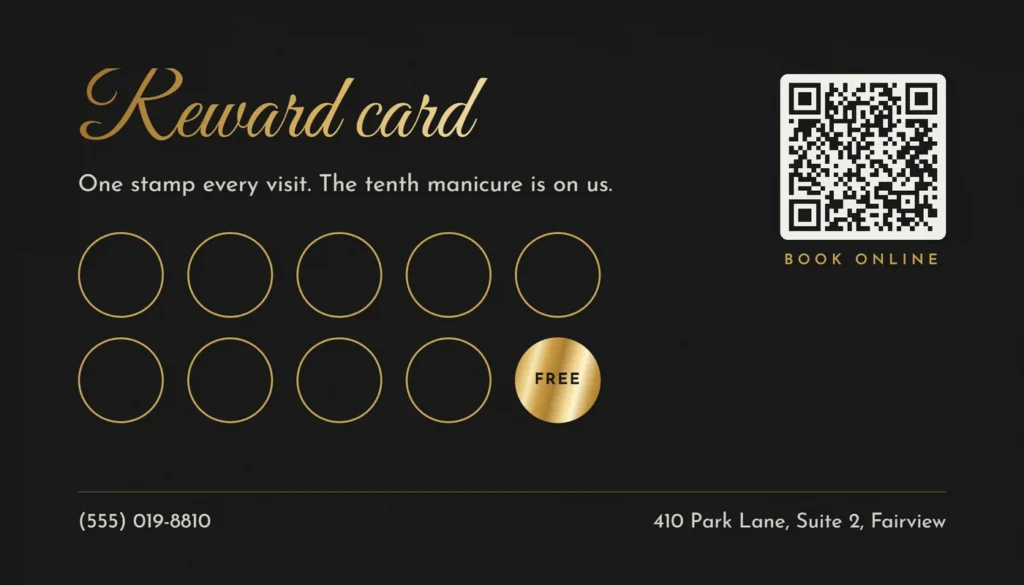
- Reward or stamp card. Eight or ten circles to stamp or punch, with the reward written clearly.
- Services and hours. A short list of services, your opening hours and a booking QR code.
- Coupon. A first-visit or referral offer with a short expiry date, so people use it.
A two-sided card costs a little more than a one-sided one, but it gets kept longer, because it does a job. Our standard business cards can be printed on the front only or on both sides.
Setting up the business card dimensions in Canva or Adobe
Canva: create a design at a custom size of 3.5 × 2 inches, then turn on "Show print bleed" in the File menu settings and stretch backgrounds past the dashed line. Download as PDF Print with "Crop marks and bleed" ticked.
Illustrator or InDesign: create a document of 3.5 × 2 inches with 0.125 inch bleed on all sides. Add a margin of 0.125 inch to see the safe area. Export as a print PDF with "Use Document Bleed Settings" ticked.
Photoshop: create a canvas of 3.75 × 2.25 inches (1125 × 675 pixels) at 300 pixels per inch, CMYK color, and place guides 0.125 inch and 0.25 inch in from each edge for the trim and safe area.
If you start from one of our design templates, the business card size, bleed and safe area are already set; you only change the words and photos.
Mistakes that ruin a good card
- Designing at the wrong size. A card designed at 3.5 × 2.5 inches and squeezed to 2 inches tall looks stretched. Start at the standard business card size.
- No bleed on a dark card. Thin white lines appear on some edges after cutting.
- Text on the edge. A phone number 1/16 inch from the trim may lose a digit's tail on part of the stack.
- Too much information. Two phone numbers, three social handles, a slogan and a list of twelve services crowd the card; move the list to the back or to a flyer.
- A tiny QR code. Codes under about 0.75 inch often fail to scan, especially near a glossy finish under shop lights.
- Type too light. Thin, light gray text looks refined on a screen and nearly disappears on paper.
- Reusing a design made abroad. A card laid out at 85 × 55 mm or 90 × 55 mm does not scale cleanly to 3.5 × 2 inches: the edges get cropped or the text crowds the trim. Rebuild the layout at the US business card size instead of stretching it.
Questions about business card size
Is 3.5 × 2 inches the standard business card size everywhere?
No. It is standard in the US and Canada. Most of Europe uses 85 × 55 mm, Japan 91 × 55 mm, and Vietnam, Australia and India 90 × 55 mm. For clients in the US, 3.5 × 2 inches is the right size.
What is the business card size in pixels?
At 300 pixels per inch, the finished card is 1050 × 600 pixels, and the file with bleed is 1125 × 675 pixels.
What are the business card dimensions in centimeters?
8.89 × 5.08 cm for the finished card, or 9.53 × 5.72 cm with 1/8 inch of bleed on each side.
Is a business card the same size as a credit card?
Almost, not quite. A credit card is 3.37 × 2.13 inches with rounded corners; a business card is 3.5 × 2 inches. Our plastic gift and membership cards use the credit card size.
Do rounded corners change the business card size?
No. The card keeps its 3.5 × 2 inch size; only the corners are cut round. Keep text a little further from the corners so nothing sits on the curve.
Will a 3.5 × 2 inch card fit a standard card holder?
Yes. Desk card holders, wallet slots and most phone case pockets are made for the standard business card size. Larger or square cards may stick out or not fit at all.
How many business cards should I order?
Think about how many you hand out in a month and how often your details change. Cards with a printed appointment or reward back get used faster than plain ones, so a shop that uses them that way runs out sooner. If your address or phone may change soon, order fewer and reprint later.
Can I order a different size?
Yes. Square and shaped cards are available as die-cut cards, and other sizes can be quoted. Tell us the size you have in mind in your request.
The short version
The standard business card size in the US is 3.5 × 2 inches. Your file should be 3.75 × 2.25 inches with bleed, with every word inside a 3.25 × 1.75 inch safe area. Keep the name first, the contact details second and everything else on the back.
When your design is ready, or if you would like us to make it, add standard business cards to your quote list. We check the business card dimensions, bleed and safe area on every file and send a proof before anything prints, as described in our guide to design and printing services.