Vinyl banner printing is the fastest way to tell a whole street that something is happening at your shop: a grand opening, a new owner, a holiday special, "Now hiring". Good vinyl banner printing produces a banner that reads from across a parking lot, survives sun and rain for a season or more, and goes up in an afternoon with a few zip ties. A poor one is too small to read, too busy to understand and torn by the first windy week.
This guide covers what we have learned printing outdoor banners for salons, restaurants, bakeries and shops: the common vinyl banner sizes and how far each one can be read, grommets and hanging, wind and weather, permits, and nine design tips that make a banner work at 40 miles an hour. It ends with care and storage, so your banner lasts to the next event.
Why vinyl banners work for small shops
A vinyl banner is a sign you can change. Permanent signs are expensive and slow to approve; a banner can go up the week you need it and come down when the event ends. It is large enough to be seen from the road, light enough to hang without tools, and tough enough for outdoor weather.
For small businesses, outdoor banners do four common jobs:
- Grand openings and reopenings: "Grand opening Saturday" tells drivers a new place exists before the permanent sign arrives.
- Seasonal promotions: holiday gift certificates, summer pedicure specials, lunch deals, catering season.
- Announcements: new owner, new services, new hours, "Now open late".
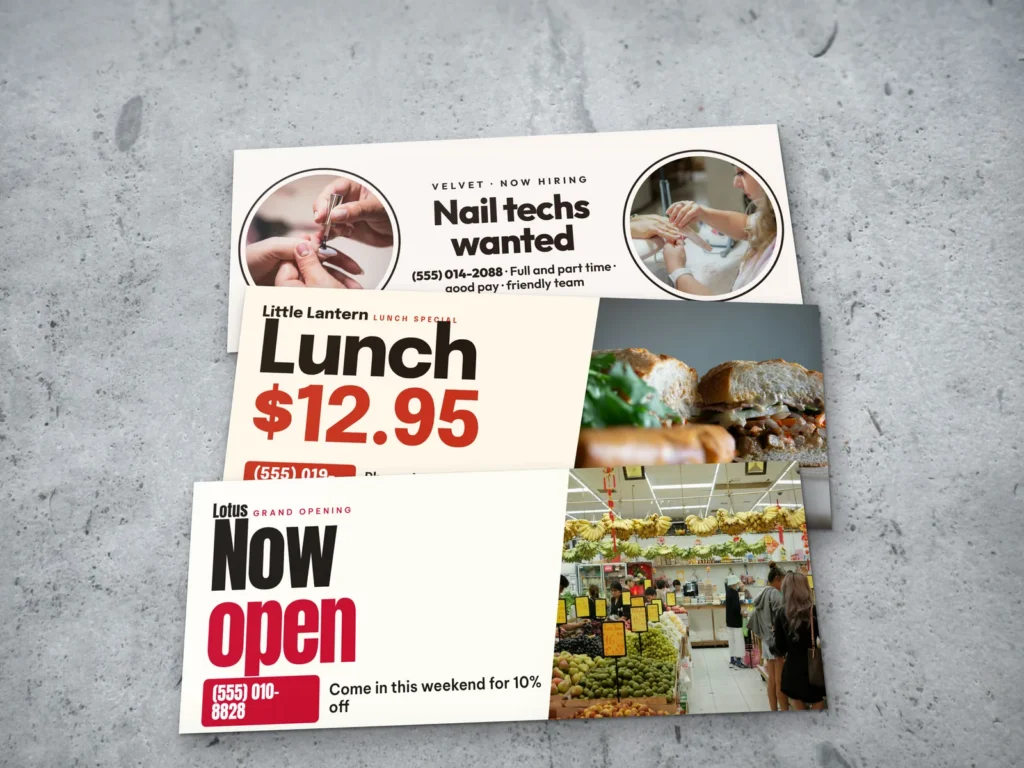
- Hiring: "Now hiring nail technicians" or "Now hiring servers" reaches people who live nearby.
Common vinyl banner sizes
Most outdoor banners for storefronts are long and short, to fit above a door, along a fence or across a shop front. We print vinyl banners in four standard sizes, and any custom size you need.
| Size | Good for | Notes |
|---|---|---|
| 3 × 8 ft | Above a single shop door, a fence, a booth | The most common storefront banner |
| 3 × 10 ft | Wider shop fronts, strip mall units | More room for a longer headline |
| 4 × 8 ft | Banners read from farther away | Taller letters fit |
| 4 × 10 ft | Large fronts, buildings set back from the road | The most visible standard size |
| Custom | Odd spaces, columns, fences, events | Measure the space and tell us |
Before you choose among vinyl banner sizes, measure the space where the banner will hang, and look at it from where your clients will see it: the road, the parking lot, the sidewalk across the street. A banner that fits the wall but cannot be read from the road is the wrong size, so think about vinyl banner sizes and reading distance together.

How far can a banner be read?
Sign makers use a simple rule of thumb: every inch of letter height can be read from about 10 feet away. It is an approximation, and bold, simple letters with strong contrast read better than thin or decorative ones, but it is a good starting point.
| Letter height | Readable from about | What it means on a 3 × 8 ft banner |
|---|---|---|
| 2 in | 20 ft | Fine print: website, small details |
| 4 in | 40 ft | Phone number, secondary line |
| 6 in | 60 ft | Strong secondary headline |
| 8 in | 80 ft | Main headline for a sidewalk or parking lot |
| 12 in | 120 ft | Headline for drivers on a busy road |
On a 3 foot tall banner, a 12 inch headline leaves room for one more line and your logo. That is why the best banner design uses few words: big letters need space, and space runs out quickly.
Grommets, hems and hanging
A banner is only as good as the way it hangs. Most outdoor banners have three features that keep them in place.
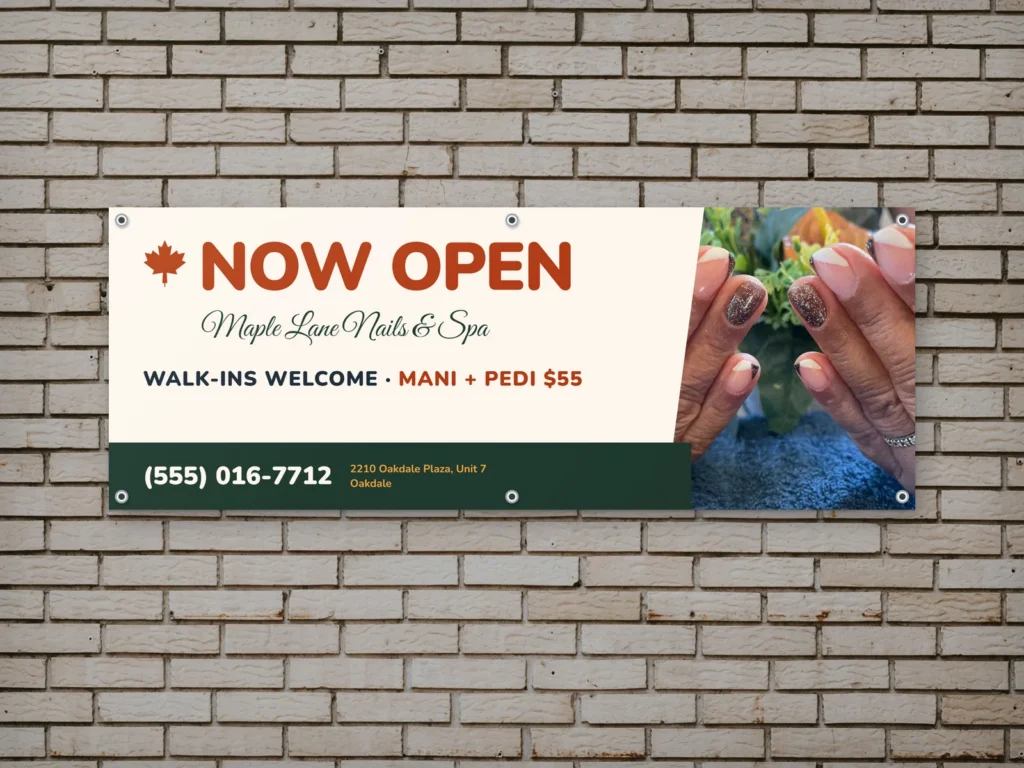
Grommets are metal rings set into the edges, so you can tie the banner with zip ties, rope or bungee cords. Banners usually get grommets in the corners and along the edges at regular intervals. If you plan to hang the banner a special way, such as on a pole or between two posts, tell us.
Hems reinforce the edges, so the grommets do not tear out in wind. In vinyl banner printing they are a small detail that decides how long a banner lasts.
Hardware is up to you: zip ties for fences and railings, bungee cords for a little give in the wind, rope for spans between posts, screws or hooks on a wall. Bungee cords are a good choice where wind is strong, because they let the banner flex instead of pulling against the grommets.
Hang the banner tight and flat. A loose banner flaps, wrinkles and wears out faster, and a sagging banner is hard to read.
Wind and weather
Wind is the main enemy of outdoor banners. A large banner on an open fence catches wind like a sail. A few habits help:
- Choose the right place. A wall or a building front protects a banner better than an open fence.
- Tie every grommet. Leaving some grommets free lets the banner flap and tear.
- Use bungee cords in windy spots, so the banner gives a little instead of ripping.
- Take it down for storms. If a big storm is coming, an hour of work saves the banner.
Outdoor banners in vinyl handle sun and rain well, but colors fade over long periods in full sun. Plan a banner for a season or an event, not for years. For permanent messages, think about window graphics or a permanent sign.
Check the rules before you hang it
Many cities and counties have rules for temporary signs and banners: how big they can be, how long they can stay up, whether they need a permit. Shopping centers and landlords often have their own rules too, written in the lease. A quick call to your city's planning or zoning office, or a look at your lease, saves a fine or an awkward conversation. The Small Business Administration's guide to licenses and permits explains that these rules are set locally.
9 tips for banner design that works
1. Say one thing
Banner design starts from this: a banner is read in two or three seconds by someone driving or walking by. Choose one message: "Grand opening", "Now open", "Holiday gift certificates", "Now hiring". Everything else is secondary.
2. Use as few words as possible
Count the words in your main message and cut until it hurts. "Grand Opening Saturday" beats "Join us for our grand opening celebration this Saturday".
3. Make the headline huge
Use the reading-distance table above. For a banner seen from a parking lot, the headline should be several inches tall at the very least.
4. Choose high contrast
Dark letters on a light background, or white letters on a strong dark color. Avoid red on black, light gray on white, and photos behind text. Contrast is what makes a banner readable from far away.
5. Use bold, simple letters
Thick sans-serif letters read best at a distance. Thin scripts and decorative fonts look elegant up close but blur from the road. Keep any script for a short word, never for the phone number.
6. Show your name or logo clearly
People should know whose banner it is. If your permanent sign is not up yet, your banner is your sign.
7. Add one way to act
A phone number, a website or a short web address, large enough to read. Skip QR codes on banners read from cars; they work only on banners people walk up to.
8. Use photos only if they are bold
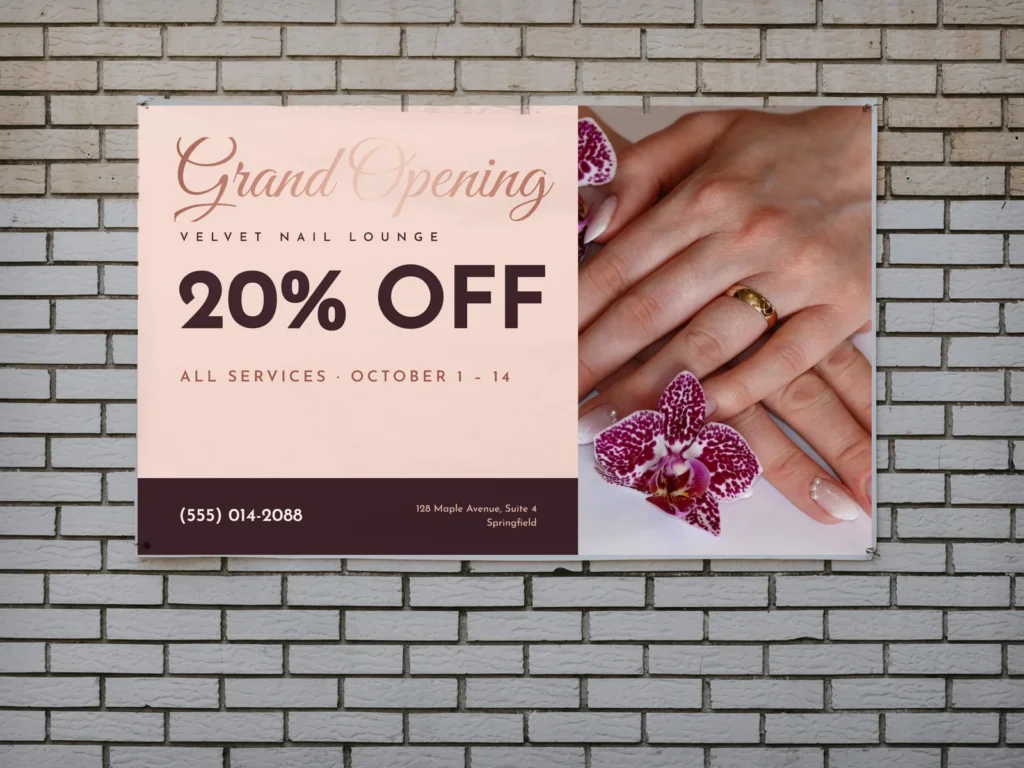
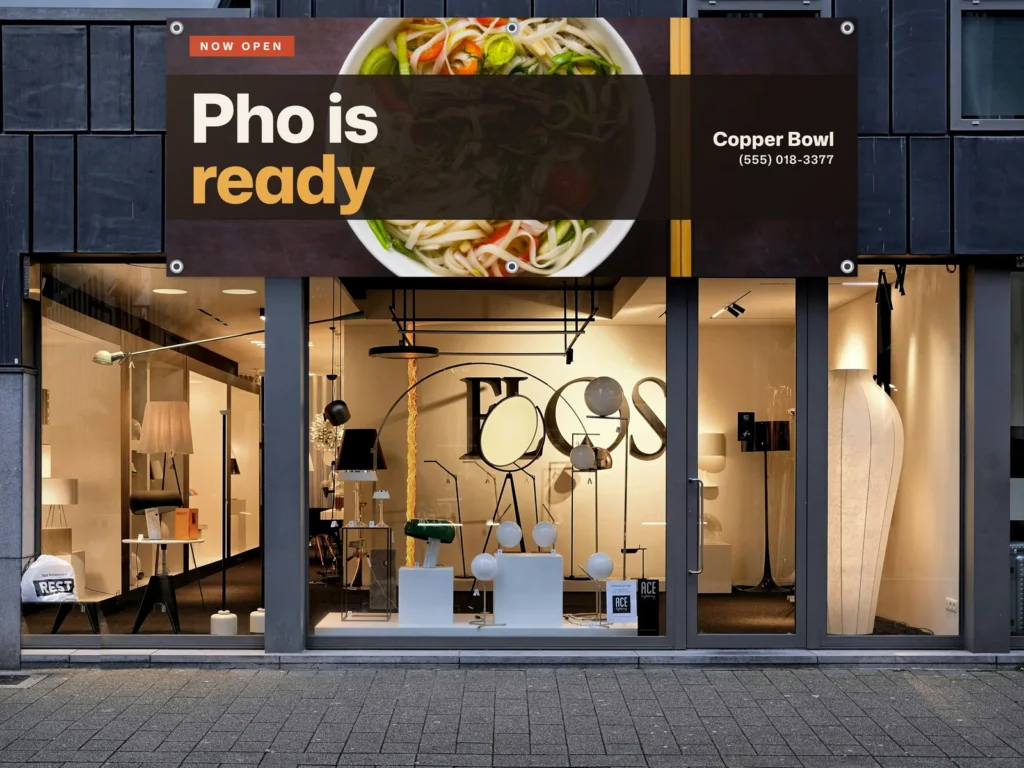
A large photo of beautiful nails, a steaming bowl of pho or a cake can work, if it is simple and the text sits on a calm area. A busy photo behind the text makes both unreadable.
9. Match your shop
Use your sign's colors and logo. When people later see your window, your cards or your flyers, the banner and the shop should feel like the same place.
Getting the banner file right
Files for vinyl banner printing are big, but they do not need the same resolution as a business card, because they are viewed from far away. Photos at about 100 to 150 pixels per inch at the final size usually look good on a banner. Text and logos should be vector or very high resolution, so their edges stay crisp.
Keep important content away from the edges, where hems and grommets go: a margin of a couple of inches is safer than the 1/8 inch used on small pieces. If you are not sure, send the design or the idea, and we set up the file with the right margins for your size. Our guides to the print-ready PDF and bleed in printing explain the basics for every printed piece.
Banner, roll-up, A-frame or yard sign?
Outdoor banners are not the only outdoor signs, and each has its place.
| Sign | Where it works | Best for |
|---|---|---|
| Vinyl banner | On the building or a fence | Events and promotions seen from the road |
| Roll-up banner | By the entrance, indoors or under cover | Services and offers at eye level, events |
| A-frame sign | On the sidewalk | Today's message for people walking by |
| Yard sign | On the lawn or at the curb | Directions, openings, events near the road |
Many shops combine two: a banner on the building to catch drivers, an A-frame on the sidewalk to catch walkers. For a grand opening, the same offer on the banner, the A-frame, the flyers and an EDDM mailing makes the whole neighborhood hear the same message.
Ideas by trade
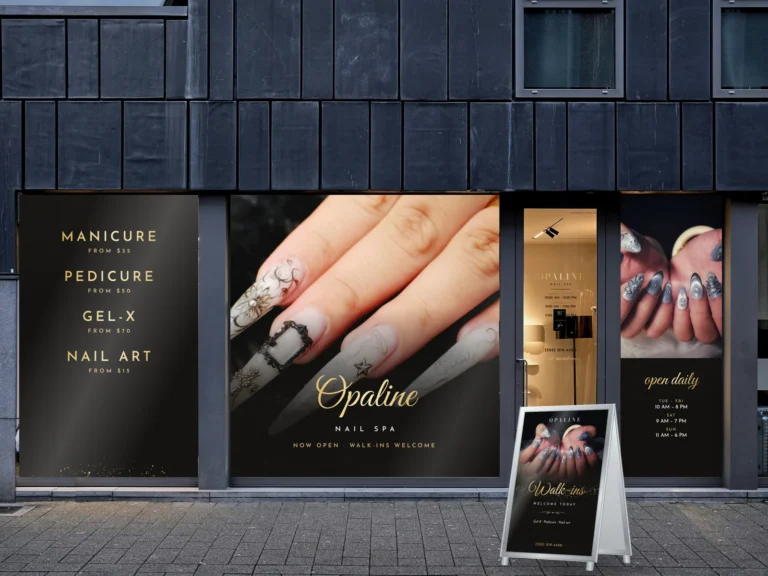
Nail salons and spas: "Grand opening", "Walk-ins welcome", "Holiday gift certificates", "Now hiring nail techs". Our guide to nail salon marketing materials shows how banners fit with the rest of a salon's printed pieces.
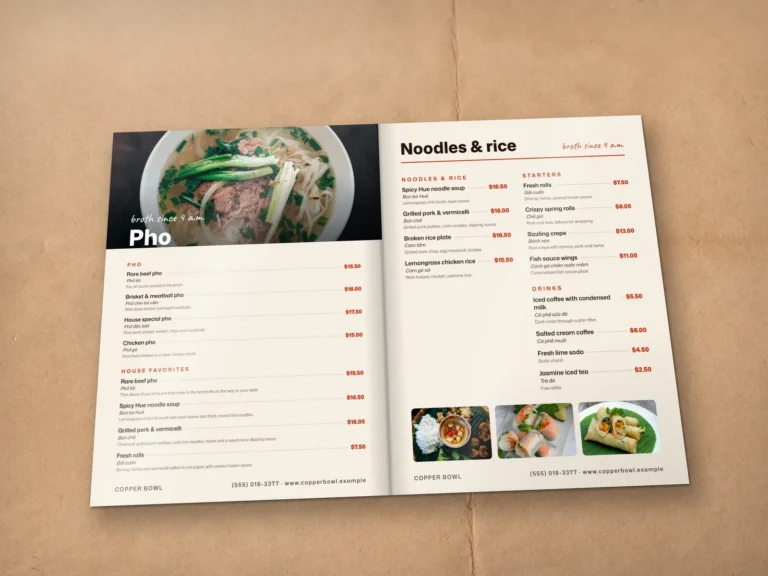
Restaurants: "Now open", "Lunch special", "Now delivering", "Catering for every party". A big photo of the signature dish can work if the text stays bold.
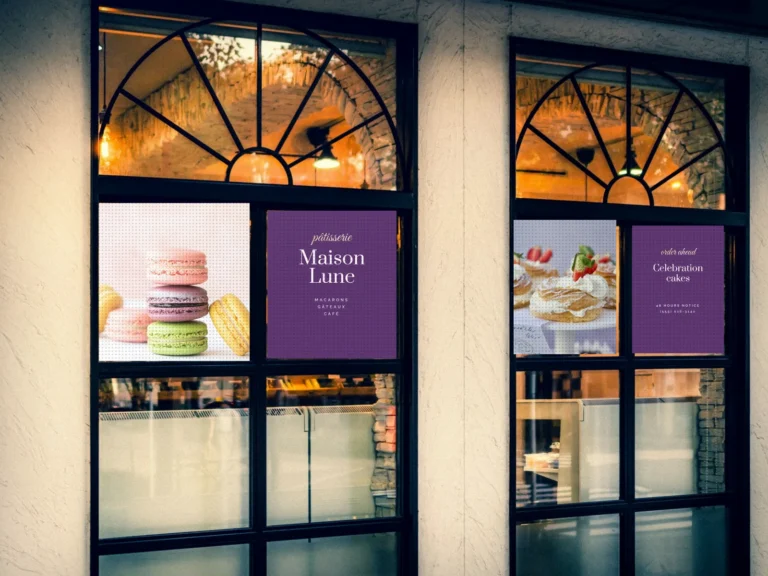
Bakeries and cafés: "Fresh bread daily", "Order your holiday cakes", "Now serving coffee".
Retail shops: "Sale", "New arrivals", "Grand opening", "Closing sale". Large numbers ("50% off") read well from the road.
Planning a banner for a grand opening
A grand opening is the most common reason for vinyl banner printing, and a little planning makes the banner do double duty.
Hang it early. Put the banner up two to three weeks before the opening day, with the date in the headline: "Grand opening Saturday, Nov 14". People driving past every day start to expect it.
Keep the message simple. The date, the word "Grand opening" and your name or logo. Put the offer, the menu and the details on flyers and the A-frame, where people stop and read.
Plan the after. Once the day has passed, a dated banner looks stale. Order a second banner, such as "Now open" or "Walk-ins welcome", to replace it the week after, or design the first one without a date and add the date with a smaller sign.
Match everything. The banner, the flyers, the window and the EDDM mailers should share the same colors and words. Repetition is what makes a neighborhood remember a new name.
Banners indoors and at events
Not every banner hangs outside. Vinyl banners work indoors too: behind the front desk for a seasonal promotion, across the back wall of a booth at a school fair or a farmers market, or above a table at a bridal show. Indoors, the reading distance is shorter, so you can add a QR code or a short list of services.
For events you attend often, a roll-up banner is easier to carry: it stands on its own, sets up in a minute and rolls back into its base. Many shops own one of each: an outdoor banner for the building and a roll-up for the entrance and events.
Care and storage
Outdoor banners that are stored well can be used again next season.
- Roll, never fold. Folds leave creases and can crack the print. Roll the banner with the printed side out.
- Clean before storing. Wipe with mild soap and water, then let it dry fully.
- Store dry and flat or rolled. Keep it away from heat and sharp objects.
- Check grommets before the next use, and replace broken ties.
Common banner mistakes
| Mistake | What happens | Fix |
|---|---|---|
| Too many words | Nobody reads it at driving speed | One message, few words |
| Small letters | Unreadable from the road | Use the reading-distance table |
| Low contrast | Words disappear in sun | Dark on light, or light on dark |
| Text near the edges | Grommets and hems cut into it | Keep a margin of a couple of inches |
| Loose hanging | Flapping, tearing, wrinkles | Tie every grommet, hang it tight |
| No permit check | A fine or a forced removal | Call your city and check your lease |
Questions about vinyl banner printing
Which vinyl banner sizes suit a storefront?
For a single shop door, 3 × 8 feet is common. For wider fronts or buildings set back from the road, 4 × 8 or 4 × 10 feet. Measure the space and think about where people will read it from.
How long does an outdoor vinyl banner last?
A banner made for outdoor use handles sun and rain for a season or an event well. Colors fade over long periods in full sun, so plan banners for events and seasons, not for years.
Do your banners come with grommets?
Yes, our vinyl banners come with grommets for hanging. Tell us if you need a special arrangement, such as grommets only along the top.
Can I put a photo on my banner?
Yes, if it is a simple, bold photo and the text sits on a calm area. Avoid busy photos behind words.
Do I need a permit for a banner?
It depends on your city and your landlord. Many places have rules for temporary signs. Check before you hang it.
Can you handle the banner design for me?
Yes. Tell us the message, the size and where it will hang, send your logo, and we design it. You see a proof before printing, as with every order; our printing proof guide lists what to check.
What file should I send for a banner?
A PDF with vector text and logo is best, with photos at about 100 to 150 pixels per inch at the full banner size. If you only have a logo and an idea, send those and we build the file.
Can I reuse a banner next year?
Yes, if the message has no date. "Grand opening" banners are one-time; "Walk-ins welcome" or "Holiday gift certificates available" can come back every year.
The short version
Good vinyl banner printing starts with the right size for where the banner will be read, then a design with one message, few words, huge letters and strong contrast. Hang it tight on every grommet, check your city's rules, take it down for storms and roll it for storage. Pair it with an A-frame and flyers so the whole street hears the same message.
When you are ready, add a vinyl banner to your quote list with the size you measured and the message you want. We handle the banner design, send a proof and print your outdoor banners in Norcross, Georgia.